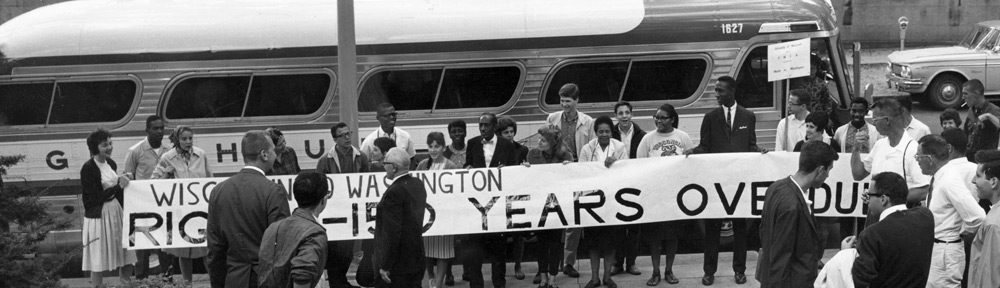
Which MLK?
Just a few days ago, the New York Times published a piece challenging the sanitized version of history that’s told every year during celebrations of Martin Luther King’s birthday. Today, King is (almost) universally celebrated in America, one of just a handful of historical figures around whom we come together as a nation. Yet, as Jason Sokol reminds us, King was far from a unifying force during his lifetime. Even a decade after his murder, he was a divisive figure, someone reviled by the conservative right. That changed after the vote to make his birthday a national holiday, but only by
Sokol’s piece serves as an excellent introduction to our study of 1960s America this semester. The past defines us: history is a story we tell ourselves to discover who we are, both as individuals and as a nation. Yet in studying the past we often learn that our most familiar stories are also the most distorted, comforting half-truths that are equal parts fact and myth.
After reading Sokol, I want you to take a minute here at the semester’s start to consider ONE of the following:
- How does Sokol’s account change your sense of what America is all about?
- How does his essay make you feel? Is it better to believe the myth or know the truth?
- How does his narrative challenge what you thought you knew about the 1960s?
Paste the question you’re answering, together with a 1-¶ response in the comment space below. Make an effort to reference particular details from Sokol: vague responses leave readers with the impression that you didn’t do the reading.
In class: Course Dogma; Myths of the 1960s; learning as process of refining initially crude preconceptions; learning history as process of consulting experts and grappling with instances/documents/fragments of a lost past.